2026 Trends of Mobile Food Business: Sustainability & Electric-Driven Food Trailers


2026 Trends of Mobile Food Business: Sustainability & Electric-Driven Food Trailers
If you have been searching, what are new trends for food trailer business in 2026, the answer is no longer a vague prediction. Across North America, Europe, the Middle East and Southeast Asia, the mobile food industry is converging on one direction: a sustainable food truck built around electric power, low-energy equipment and lightweight structure. In this guide, we break down the four trends shaping 2026, why operators need to act now, and the eco-friendly upgrades Wecan can build into your next unit.

1. Sustainability Has Moved from Marketing Tagline to Operating Requirement
Five years ago, "green" on a food truck was a sticker. In 2026, it is a procurement criterion. City zero-emission zones are expanding in London, Paris, Amsterdam and parts of California; festival organizers, airport concessions and national parks now ask for documented noise and emission limits before they even issue a vendor permit. At the same time, consumers in key export markets say they would choose an eco-friendly mobile kitchen over a conventional one for the same menu. The result: sustainability is no longer a marketing story. It is the price of entry to the highest-paying locations.
2. Electric-Driven Food Trailers: Quiet, Clean and Location-Friendly
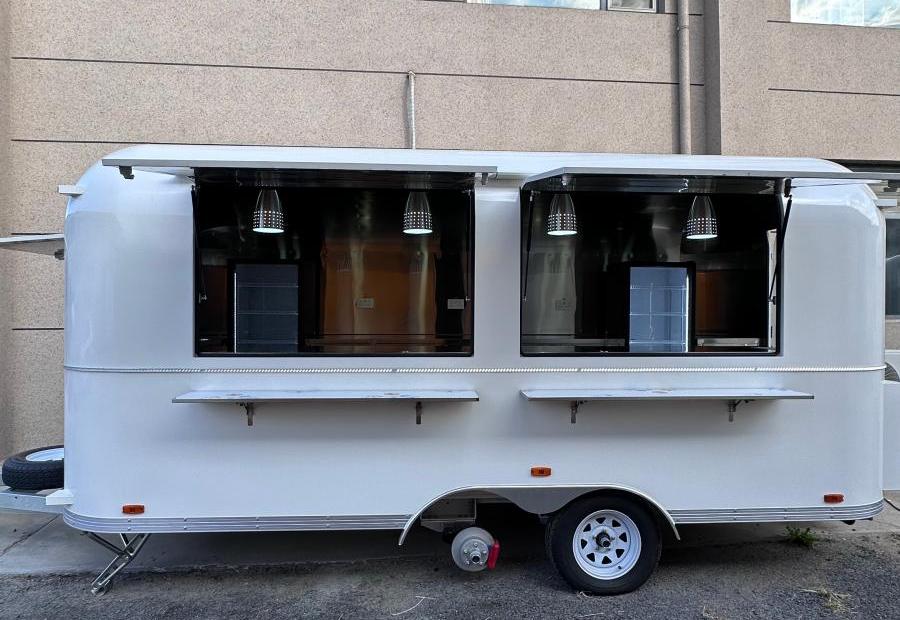
The single most visible shift in 2026 is the rise of the electric food trailer. "Electric" here does not mean swapping one fuel tank for another. It is a platform decision that touches the chassis, the power system and the daily operating cost of the unit.
2.1 What an Electric Food Trailer Actually Includes
· Battery-electric or range-extender traction option suitable for towing or self-propelled use.
· On-board lithium storage that runs the kitchen for a full service shift without a generator.
· Silent daytime operation — no diesel exhaust, no radiator fan, no vibration through the counter.
· Compliant with indoor markets, hospital campuses, green hotels and residential events that ban fossil-fuel generators.
2.2 Where an Electric Food Trailer Gives You a Real Competitive Edge
An electric unit opens doors that a conventional trailer simply cannot: morning farmers markets next to hotel guests, indoor pop-ups, evening concerts with strict curfew noise rules, and corporate campus contracts that require zero tailpipe emissions. For fleet owners, a quieter powertrain also means lower maintenance, fewer moving parts and a longer resale horizon. If you are configuring a new unit, it is worth specifying the electric option upfront rather than retrofitting later, because battery capacity, cable routing and chassis weight must be designed in from the first drawing.
3. Solar-Powered and Low-Energy Kitchen Equipment
Powering an entire kitchen on batteries is only half the equation. The other half is drawing less power per dish. In 2026, the most profitable eco-friendly mobile kitchens pair on-site generation with purpose-built, low-energy appliances.
3.1 Off-Grid Operation Without the Generator Noise
Roof-mounted solar arrays are no longer a novelty on custom trailers. Paired with a modular battery bank, a solar-plus-storage package can keep the refrigeration, lighting, POS system and exhaust ventilation running through the day, and top itself up between services. That means you can set up at a beach, a vineyard or a remote festival field where grid power does not exist.

3.2 Energy-Efficient Appliances That Cut Daily Operating Costs
· Induction hobs and combi ovens that use 30–50% less energy than open-flame gas equivalents.
· Inverter-driven compressor fridges and freezers that hold temperature with minimum draw.
· LED task lighting and dimmable strips that barely load the battery bank.
· Water-saving spray valves and on-board grey-water recycling that cut both utility weight and refill trips.
Lower wattage does not mean lower output. Modern induction and inverter equipment reaches the same cooking temperature — it simply gets there with less electricity, which is exactly what a solar or battery system rewards.
4. Lightweight Structure Equals Lower Energy Use
Every kilogram the trailer does not have to carry is energy you do not have to store. In 2026, builders are moving away from heavy, welded steel bodies toward aluminium chassis, insulated sandwich panels and cleverly folded cabinetry. The benefits compound: a lighter body tows with a smaller vehicle, needs a smaller battery, brakes sooner, and puts less stress on every component. For export buyers, a lighter tare weight also helps stay under legal tow limits in the destination country and frees up payload for commercial-grade kitchen equipment.
5. Why Operators Should Care About These Trends Now
It is tempting to treat sustainability as a 2028 problem. Three reasons say otherwise:
· Access to premium venues. The highest-margin locations — stadiums, airports, green festivals, corporate campuses — are writing emission and noise rules into their vendor contracts today.
· Total cost of ownership. Electricity, even grid-charged, is cheaper per service hour than bottled LPG or diesel. Solar and low-energy appliances widen that gap every year.
· Resale value. A battery-ready, solar-prepped, lightweight unit will hold its value far better in three to five years than a fuel-only build that the next buyer has to de-risk.
In short: the unit you order in 2026 is the unit you will be running through 2032. Building for the low-carbon baseline now avoids a forced rebuild later.
6. Wecan's Eco-Friendly Customization Options
At Wecan, we have been building custom mobile kitchens for export markets for years, and our 2026 configurator now treats sustainability as a first-class option set rather than an afterthought. Depending on your menu, your towing vehicle and your target markets, we can spec any combination of the following:
6.1 Available Green Upgrades
· Electric / hybrid chassis and on-board lithium battery packages sized to your daily menu.
· Roof-mounted solar arrays with charge controllers and inverter-ready outlets.
· Low-energy induction, inverter-fridge and LED lighting packs.
· Lightweight aluminium body and insulated sandwich-panel construction.
· Fresh-water and grey-water tanks optimized for refill interval and weight.
6.2 How to Start Your Custom Build
Every sustainable food truck we ship is built around a real menu and a real route. Send us your equipment list, your target countries and your towing vehicle, and our engineers will come back with a power balance sheet — how much solar, how much battery, how much headroom — before we cut steel. You can start the conversation on our custom food trailer page, or read more about our electric trailer line and solar power packages. If you would like to see how we work with overseas buyers end to end, our company profile covers the export process and factory inspection.


7. Bottom Line
The 2026 mobile food business is converging on a single shape: a quiet, battery-assisted, solar-capable, lightweight unit that can serve a plaza at dawn, a beach at noon and a rooftop after dark — without a generator. Whether you are a first-time buyer or a fleet owner, the question is no longer whether to go electric and low-energy, but how much of that package to build in on day one. Talk to Wecan, and let us spec the sustainable food truck your next five years of menus will run on.
Online message
# contact us
Materialise Your Vision

-
No. 09, Building 40, No. 60, Wangsha Road, Chengyang District, Qingdao, Shandong, China
-
britney@qdwecan.com
E-mail: